
When something makes us anxious, the instinctual reaction is often to avoid the feared stimulus. This is very common: who among us hasn’t procrastinated a big task, put off making phone calls or having a difficult conversation with a friend?
We can distinguish between different types of avoidance:
- Behavioral avoidance – avoiding certain places, people, things or tasks. Example: avoiding the dog park if you are afraid of dogs
- Cognitive avoidance – actively suppressing or distracting yourself from distressing thoughts or memories. Example: avoiding a memory of being attacked by a dog
- Emotional avoidance – Suppressing or distracting yourself from intense, unwanted emotions, or trying to feel a different emotion instead. Example: Getting on your phone the moment you see a dog
Avoidance plays a huge role in many psychological disorders:
- Post-traumatic stress disorder (PTSD) – avoiding both external reminders, such as places, smells or people, and internal reminders, such as memories, thoughts or feelings associated with the traumatic event.
- Obsessive-compulsive disorder (OCD) – avoiding situations that trigger obsessions or compulsions (behavioral avoidance), or avoiding obsessions by performing compulsions
- Depression – avoiding social situations and activities, which further reinforces low mood
- Specific phobias – avoiding situations where you could be faced with the trigger (such as avoiding dogs)
- Generalized anxiety disorder (GAD) – avoiding any feared situations or stimuli
- Social anxiety disorder – avoiding social situations
In this blog post, I will explain how avoidance maintains and worsens anxiety, and give you tips on how to break out of the cycle.
What is the avoidance-anxiety cycle?
Anxiety is your body’s way of protecting you from danger, when the brain senses threat. In dangerous situation, this is great, as it gets you to move away from the danger. However, this system is too often activated by normal, everyday things that don’t actually pose a threat. And when you then avoid the thing you fear, you run the risk of entering into this vicious cycle:
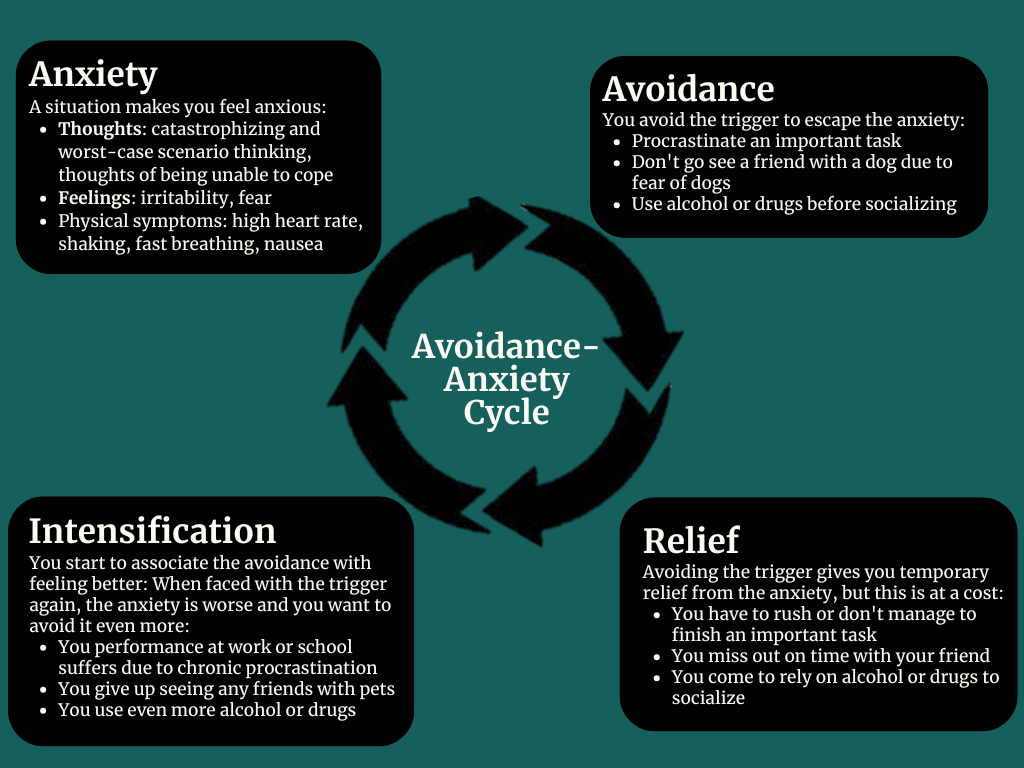
The cycle typically looks like this:
- Trigger – something causes anxiety
- Anxiety increases – you feel fear, your thoughts are racing and you have a physical response
- Avoidance – you leave the situation, cancel the plan, procrastinate a task or distract yourself
- Short-term relief – anxiety decreases as the ‘threat’ is gone.
- Long-term reinforcement – Your brain learns that avoidance works. Next time, you may feel anxious faster, and the distress is stronger.
Why avoidance increases anxiety
- The fear never gets disconfirmed – if you always avoid something that makes you anxious, your brain never learns that the situation might actually be manageable. Example: You don’t learn that some digs are very friendly
- Your brain learns that avoidance = safety – when your anxiety goes down after avoiding, your brains sees it as proof that avoidance kept you safe, and starts to rely on avoidance as a primary coping strategy. So, if you avoided the dog, your brain thinks that’s what prevented an attack
- Life gets smaller – as avoidance grows, you start to restrict your life (stop going to social events, delay important tasks, etc.). Over time, this leads to even more stress, lower confidence in yourself and increased social isolation, which further fuels anxiety.
Signs you might be stuck in the anxiety-avoidance cycle:
- Chronic procrastination
- Frequently canceling plans at the last minute
- Over-preparing to avoid mistakes
- Needing to constantly stay busy to avoid distressing thoughts or feelings
- Constantly distracting yourself with screens or work
- Avoiding your thoughts, memories or feelings
You may feel frustrated at yourself for these patterns, not realizing that avoidance has served as a protection from intense feelings.
How therapy can help
One of the most effective treatments for anxiety is Cognitive Behavioral Therapy (CBT). CBT focuses on understanding how thoughts, feelings, behaviors, and physical sensations influence each other.
In the avoidance–anxiety cycle, therapy often focuses on two main areas: changing unhelpful thinking patterns and gradually reducing avoidance through exposure.
Step 1 – Understanding the anxiety/avoidance pattern
A therapist can help you identify:
- The situations that trigger anxiety
- The thoughts and feelings that appear in these moments
- How your body reacts physically
- What you usually do to cope (avoidance, distraction, etc.)
Using social anxiety as an example:
- Situation – meeting new people
- Thought – “Everyone will think I’m weird”
- Feeling – fear, uncertainty
- Physical reaction – Tension in the shoulders, shaking
- Coping – cancelling plans
- Short-term consequence – relief from anxiety
- Long-term consequence – anxiety about social situations gets worse, leading to an unsatisfying social life
Understanding this pattern can help you predict and manage your anxiety better.
Step 2 – Challenging anxious thoughts
Anxiety often involves catastrophizing, and CBT can help challenge these catastrophic thoughts using a technique called cognitive restructuring, using questions like:
- What evidence supports this thought?
- What evidence contradicts this thought?
- What might a more balanced realistic thought be?
Using social anxiety again as an example:
The anxious thought: “If I stumble on my words, everyone will think I’m weird”, might become a more balanced thought: “Most people stumble on their words sometimes, and it’s not as noticeable to others as it is to me”.
Step 3 – Gradual exposure to feared situations
An integral part of CBT for anxiety includes exposure, which involves gradually and intentionally facing situations that cause anxiety, rather than avoiding them.
The goal is not to get rid of the anxiety immediately, but instead helping the brain learn the following:
- The feared situation is often less dangerous than it predicts
- You are capable of handling the anxiety when it comes up
Exposure usually takes place step by step, using an exposure hierarchy. For someone with social anxiety, it might look like:
- Making small talk with a service worker
- Attending a small gathering for 20 minutes
- Speaking in a meeting when you usually stay silent
- Giving a presentation of 10 minutes
Each step allows you to build confidence to face even more challenging situations.
Step 4 – Learning that anxiety naturally decreases
One important discovery during exposure work is that anxiety rises and falls naturally over time. When people stay in a feared situation long enough, they often notice that the anxiety eventually decreases, even without escaping or avoiding.
This process is called habituation, and it teaches the brain that the situation is survivable. Over time, the fear response becomes weaker.
Step 5 – Building confidence through doing (experience)
The biggest change does not happen in the therapy room, but it comes through new experiences.
Instead of learning: “Avoidance is the way I can cope with anxiety”, you can learn that:
- “I can tolerate discomfort”
- “I can handle difficult or scary situations”
- “My fears are not always warranted or accurate”
Here, a therapist might teach you techniques from acceptance and commitment therapy (ACT) to help you accept your anxiety, and techniques from dialectical behavior therapy (DBT) to help you move through difficult feelings and sensations, such as urge surfing and other distress tolerance methods.
It is of course entirely possible for you to try to go through these steps on your own, if you don’t have access to therapy, but if you find you are struggling, staring therapy can be a great way to get support and guidance as you work on breaking the avoidance-anxiety cycle.
References
Lehrbach, K. R., et al. (2023). Anxiety sensitivity and experiential avoidance: Relations with anxiety severity and treatment outcomes.
Mowrer, O. H. (1947). On the dual nature of learning: A reinterpretation of conditioning and problem-solving.
Hofmann, S. G., et al. (2012). The efficacy of cognitive behavioral therapy: A review of meta-analyses.
Gloe, L. M., et al. (2026). Effects of exposure therapy versus CBT on avoidance and impairment in childhood anxiety.